KIMBARRY
Wine Cellar Cooling Unit Replacement: What to Check Before You Approve the Drawings
Before approving a wine cellar, check the opening, turning space and staging area needed to remove the selected cooling unit. Record the route at handover.
KIMBARRY Editorial · · Updated
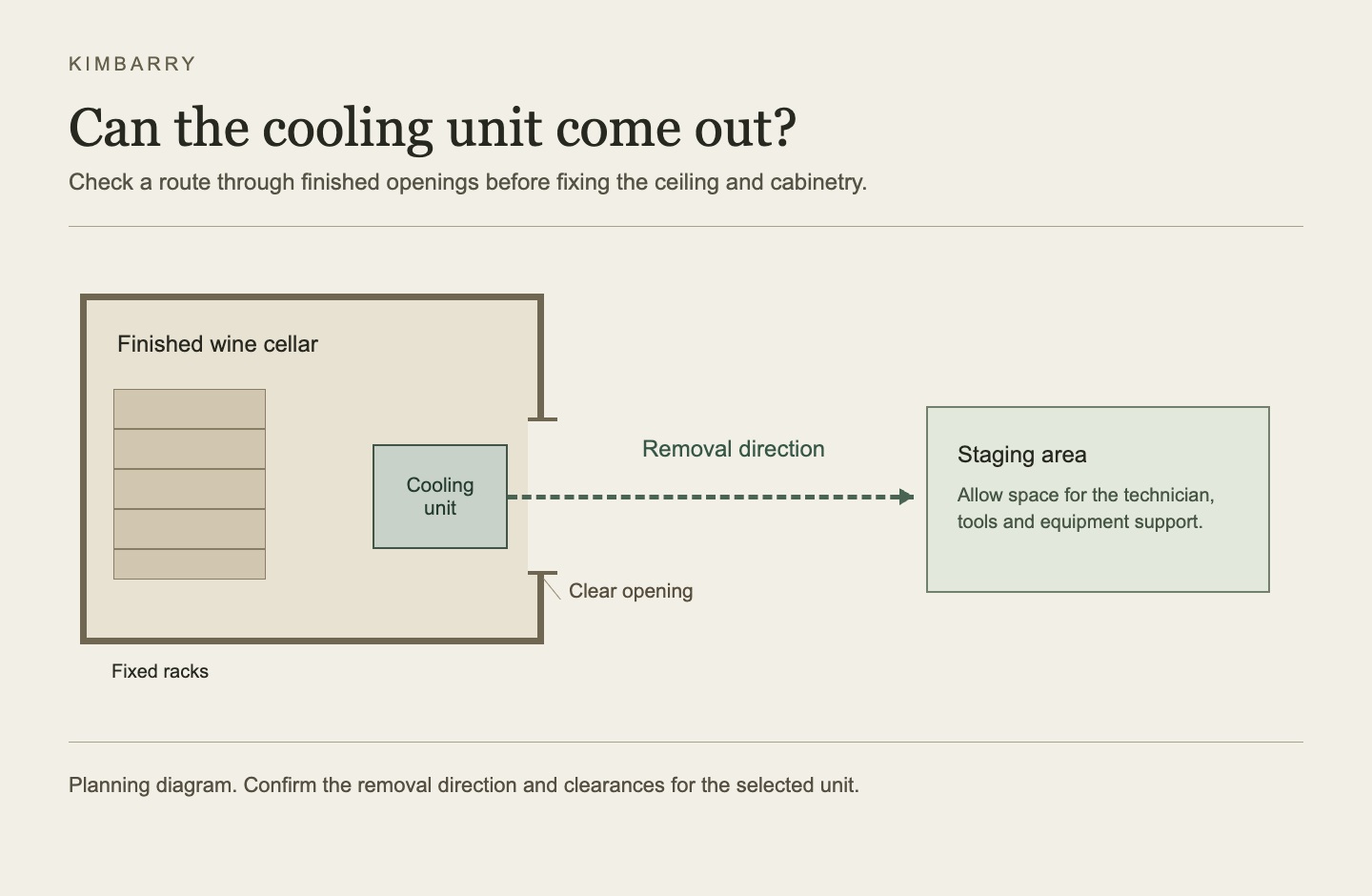
Before approving your wine cellar drawings, ask the team to show how the selected cooling unit, or the largest part that must be removed, will come out once the shelves, doors and ceiling are in place. Look for an opening the part can clear, room to turn and handle it, and a place to support it during removal. A hatch that lets a technician reach the filter can still leave the unit trapped behind the finished cabinetry.
What to look for on the drawing
Imagine a unit that has to slide forward into a hallway. The technician can reach the service panel, but a new cupboard sits in the path the unit needs to travel. The drawing may be adequate for routine maintenance, but it still needs a way to get the unit out. Depending on the equipment instructions and the finished layout, the solution might be to make part of the cupboard removable, shift the opening or select a unit that can be withdrawn in a different direction.
As the lead contractor for a KIMBARRY wine cellar, we bring the equipment, cabinetry and site drawings together before fabrication. We use the supplier's instructions to identify the assembly that has to come out and its removal direction. Then we measure the opening between finished surfaces and follow the path past the door frame, shelf ends and any turns. On the drawing, the route should end at a place where the installer can safely support the part. If the supplier changes the model or the cabinet maker changes the opening, we check that route again before releasing the affected work.
How to check it before the work is covered
At the site, compare the narrowest opening and tightest turn with the drawing, including the thickness of finishes still to be fitted. If the fit is close, a full-size lightweight template can show where a part would catch or where it cannot turn. The installer should separately confirm how the actual unit will be disconnected, supported and moved. If the route depends on a removable panel, check who will open it and how they will restore the finish and any seal it forms.
What to collect at handover
Ask for the installed model and its service instructions, the updated drawing showing the actual removal route and removable panels, and the commissioning record. Together, these let a future technician identify what is fitted, where to start and how the system was checked when it was handed over. For a project with a local service team, confirm who handles the cooling equipment, who reinstates the finishes and who coordinates the work. KIMBARRY confirms the scope of on-site support, response times and warranty in the project contract.